Pages

Apr 22, 2020

"Faithful Neighbors, and the Like."


By Molly Barnett

Over a month ago, before our state imposed stay-at-home laws, my husband and I  heard a knock at the kitchen door as we relaxed on the couch after our son went to bed. Slightly rattled by the unexpected greeting, I gingerly walked to the door, and cautiously gazed out the window only to see our neighbor smiling and waving on the other side of the glass. In that moment I simply had to laugh at my previous suspicion and realized with embarrassment who I had become in this age of texting. What once upon a time had been an expected sound at the door, had become a surprise! Long story short, our neighbor had simply stopped by to ask if we needed anything from the store, which then led to him spending a little over an hour with us in our living room, conversing delightedly and reciting poems we have memorized. Yes, you read that correctly--poetry! God has been too good to us in terms of who we have as physical neighbors. 

So then I began thinking about the gift of good neighbors as Luther explains in the fourth 
petition:
Give us this day our daily bread. What is meant by daily bread? Daily bread includes everything that has to do with the support and needs of the body, such as food, drink, clothing, shoes, house, home, land, animals, money, goods, a devout husband or wife, devout children, devout workers, devout and faithful rulers, good government, good weather, peace, health, self-control, good reputation, good friends, faithful neighbors, and the like.

According to this list of daily bread, we have been blessed immeasurably! Thus, I have been pondering the gift of good neighbors and the calling we have to act as faithful ones to those around us. 

I met these neighbors by pure coincidence almost one year ago. With my eight-day-old son in arms, I took a short stroll outside around the courtyard and ran into my neighbor who greeted me kindly, which led to introductory remarks. Following interactions then led to a friendship of families. These are the neighbors for whom we pray in the fourth petition. The wife and mother of two used to hold weekly soup lunches for her other friends who are mothers with children, and I witnessed her selfless hospitality extended to all of us week after week. These simple gatherings allowed all of us mothers to share the happenings in our lives and often seek advice on child-rearing. In addition to these social gatherings, our neighbors freely lent us their high chair for our son to use, toys, diapers when I suddenly ran out and needed one immediately, and other odds and ends. I knew then and still know that if I reach out with a need, they will respond to lend a helping hand. In many more ways, they have taught us how to be faithful neighbors.

So what do “good neighbors” look like now in this time of isolation? We as Christians are called to remain faithful neighbors in all times. At the least, we can utilize the wise use of our phones and technology to remain in contact. A simple, “how are you today?” might be just what our neighbors need. A good dose of human creativity seems to be on the rise where we live. Many neighbors in the community are engaging in a “teddy bear hunt” wherein participants place teddy bears in their windows for walkers to seek and find. This little game has become a delightful ray of sunshine in an otherwise cloudy atmosphere. 

Although these little acts may help lift our neighbors’ downcast spirits, we ought to continue praying fervently for them as well. In fact, as Christians, that is arguably the best way to be a faithful neighbor. “How are you? How can I pray for you?” we might ask. 

I continue to pray for the health of this nation and hope that once the restrictions are lifted, we might return to acting as faithful neighbors in a more physical way by picking up groceries, knocking on doors to say hello, helping repair broken belongings, and watching one another’s children. For now, and always, let us continue lifting our prayers to our Heavenly Father to grant us faithful neighbors and help us be them. 


***

Molly Barnett lives with her husband and son in Alexandria, Virginia where they are members of Immanuel Lutheran Church. Before becoming a mother, she taught fourth grade for six years at the classical Immanuel Lutheran School. She holds a B.A. in English from The Ohio State University and an M.A. in liberal arts from St. John's College in Annapolis, Maryland. Her favorite activities these days include walking outside with her family, playing the piano, and competing against her husband in various board games. 

Image source.

Apr 14, 2020

Memorization for Moms (and Other Busy Ladies)


By Heather Judd

Gradually I am learning how much more pleasant life is when we embrace the present season rather than covet the blessings of the past or the future.  This includes not coveting how my neighbor seems to be in the same season of life and yet accomplishing so much more than I can manage.  My selfish heart is so very good at seeing the blessings I don’t have and the crosses I do while ignoring the good I would miss and the pains I would suffer if circumstances differed.

In my present season of baby-raising, I could make a long list of things I am not currently accomplishing:  learning German, reading epic poems, sewing adorable toddler toys, staying abreast of the news, writing regularly, let alone keeping the kitchen floor free of crumbs and yogurt splotches.  However, I have found that this is a very good season of life for something with a different sort of value:  memorizing.

I stumbled my way into memorization through sleepless nights with a colicky infant, but as I have incorporated it into the rhythms of my days, I have come to appreciate how wholesome it is for mind and spirit.  In the interest of encouraging others to share the refreshment of memorization, I offer some of the practicalities I have learned.

Memorize for Meditation

As grammar students of all ages can attest, memorization can be a stressful drudgery, but it needn’t be.  You, dear friend, are not a pupil under the tutelage of a demanding taskmaster, and your goal is to memorize not for Friday’s recitation grade but for life.  Memorize for life.  That is the key to refreshing, meditative memorization.

Since we are memorizing for life, we will choose to memorize things that we can love, treasure, and admire until our dying breath.  Scripture, but also the Catechism, the creeds, hymns, collects and other prayers, as well as poetry that delights your heart are all eminently suitable.  
So much to memorize!   If your impulse is to scribble a list and make a schedule or plan, please stop.  Simply start with something.  An excellent course is to pick up a hymn or a section of the Catechism that you sort of know but want truly to learn by heart.  The rapid results of a little study on such a thing are very encouraging.  

Have the Right Materials

Every home should have a Bible, a Catechism, a hymnal, books of poetry . . . and none of these beautiful bound books is conducive to studying for memorization.  Set them open on your kitchen counter while preparing dinner, and the gravy will assuredly slop onto their lovely pages.  Nor are they handy to haul around in the stroller or diaper bag.  

Instead, opt for thin, small, replaceable options.  My memorization of the Catechism benefited greatly from the booklet format “A Simple Explanation of Christianity.”  Your church may have these available, or they can be purchased through CPH.  Raid your Sunday bulletins for printed copies of collects, Scriptures, hymns, or the like.  I gleefully saved this past year’s Reformation bulletin, which had all the hymns of Divine Service Setting 5 printed out.  Sometimes copying or typing out things you wish to memorize provides the handy format you need.  For Lent I typed out the words to a slew of Lenten hymns so that I had my own little study booklet.

Don’t Set a Schedule

Remember, we are memorizing for life.  Although schedules and deadlines may have motivational power, they also have the power of guilt if not strictly obeyed.  Of course, you may choose to focus on some particular piece of memorization before you will move on to others, but remove the stress of planning to finish it by a certain date.

It really is possible for memorization to be soothing, not stressful.  Let your memory work be a comfortable companion, whose presence you will enjoy for the rest of life.  You wouldn’t set a deadline by which you must form a friendship with another person, and you surely know that a few dear friends are worth more than a host of shallow friendships.  So what if you only manage to memorize one of the Catechism’s six Chief Parts in an entire year?  That little addition to your personal “word hoard” is now your treasure forever.

Connect to Common Activities 

While schedules and deadlines may not be helpful, regularity is.  Ironically, the way I’ve found to make memorization restful in the busyness of motherhood is to tie it to other activities rather than giving it dedicated time.

I first began re-memorizing the Catechism during the long months when my infant son was waking every one to two hours all night long.  I was exhausted, and yet I struggled to fall back asleep after each nighttime waking.  Somehow in my haze I struck upon the method of mentally reciting the Catechism while listening to the whir of the white noise machine.  Made it to the Sixth Commandment last time before falling asleep?  Then pick up with the Seventh this time.  

As my knowledge of the Commandments solidified, I wanted to review the other Chief Parts, but those needed more work.  I put up a bulletin board above the changing table, and at every diaper change I worked on a portion of the Catechism posted there.  To this display, I added a hymn or two that I could sing to my son before bed or upon waking.  With a little intention and a lot of repetition, these too made their way into my memory.  Currently, I work on memory while taking stroller walks, which has the added benefit of making my exercise time pass more pleasantly. 

Find the activities and times that work for you.  Post your current memory piece by the kitchen sink or the stove.  Tape it to the vacuum.  Store it into the laundry basket.  Place it in a Ziploc bag in the shower.   

Make It Stick Like Velcro

The ancient Romans were fond of the maxim “repetition is the mother of memory.”  It is certainly true that memorization requires repetition, but mindless repetition is not enough.  You need memory hooks.  These are the specific little details that you note to keep your mind in the right place as you recite.  Find enough of them, and the words will stick to your mind like Velcro.

Most things worth memorizing have built-in memory hooks.  The rhyme of poetry or the Trinitarian structure of creeds are simple examples.  Perhaps some alliteration catches your eye, or you might note the parallel construction in a hymn stanza or the logical narrative which a group of stanzas follows.  Other times, some particular phrase will just strike you and become a personalized memory hook.

Repeat, Review, and Rest

If memorization is a completely new foray for you, it may seem daunting.  However, regardless of experience or inexperience, the truth is that we all start the same way.  Begin with a small portion, such as one hymn stanza or Scripture verse, and study it phrase by phrase.  As the days turn to weeks, you can add more while also reviewing what you have learned.  Somewhere in the months beyond, you can establish a comfortable rhythm between recitation and new memory work.

Deep memorization consists of several distinct steps.  The initial learning is usually nothing more than rote back-and-forth between reading and repeating aloud.  Next comes the process of trying to recite, while stopping to check and correct as needed.  Once most of the errors and gaps are eliminated, there must be a certain amount of deliberate repetition to reinforce memory.  Finally, the piece is truly learned by heart, and you may recite it as your own with restful confidence.  

The loveliness of these steps is that they require differing amounts and types of attention, thus lending themselves to differing situations and states of mental vigor or fatigue.  I can always work on reinforcing memory while cleaning the bathroom, but learning something new is better done when I can have the written copy at hand.  On a day when my mind is cloudy with angst, I may simply soothe it by reciting stores from my learned-by-heart treasury.  When I am feeling more brisk, I may push my mind up several of the more rigorous steps in one session.  

This brings us back to the importance of meditative memorization.  In the early steps, your contemplation of the words will help you find your memory hooks.  As you review, your mind will be able to ponder the text in even greater detail, sometimes finding insights in what had previously seemed mundane phrases.  

Yet, there will also be those moments when you straighten up from wiping oatmeal blobs off the floor only to realize you’ve just recited an entire psalm without paying one ounce of attention to its meaning.  Fear not.  Simply move on.  There will be time enough for meditation at some other opportunity.  After all, you are memorizing for life.


***

Heather is a pastor's wife in rural Illinois, prior to which she was a teacher in a classical Lutheran school in Wyoming and spent time in the Washington, D.C. area working on a master's degree in English.  She has an abiding love for reading, baking, deep intellectual conversations, and persistent Lutheran matchmakers.

Post image is in the public domain. 

Apr 6, 2020

Paintings for Holy Week: The Life, Death, and Resurrection of Jesus in Art


By Anna Mussmann

One of the worst things about celebrating Holy Week without the chance to go to church is how easy it is to lose the sense that our Lord’s death and resurrection is something we celebrate with all Christians throughout the ages. Christ died and rose for each of us, yes, but also for all of us. In times of struggle and suffering, there is great comfort in remembering the cloud of witnesses who have gone before us and the communion of the saints in which we join. 

We are part of the Body of Christ no matter how long we must self-isolate.

Our ability to participate in Holy Week services online is a blessing, of course, and we can rejoice in hearing God’s Word through that medium. Yet I think it is also helpful to find other ways to join Christians throughout the ages in contemplating what our God has done for us. 


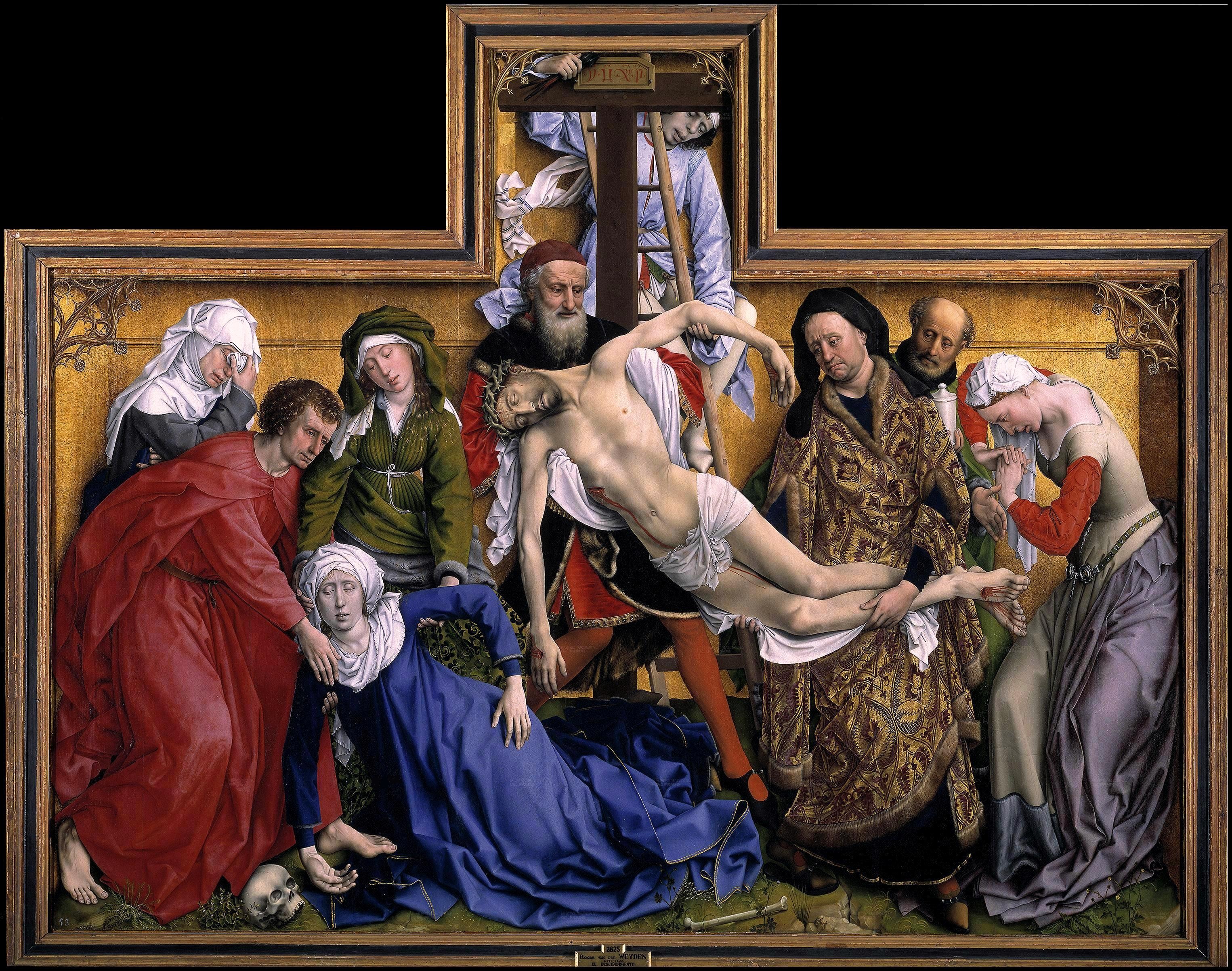
That's why I don't want to focus only on modern Sunday School-style crafts this week. My children and I will be looking at the life of Christ through art. Painters throughout history have created works that remind us of our Savior’s acts for us. We will study a variety of paintings from different time periods--some will help us “review” the life and ministry of Jesus, and others will provide an opportunity to think more deeply about His suffering and His triumph over death for us. Looking at Scripture through the eyes of artists from different times and places is something I find both moving and comforting. I hope you find this “picture study” useful!


Here are the Resources We Will be Using 


Slide Show

I’ve made a Google Slides presentation with art and Scripture. You can access it here. Because my children are young and their attention spans are limited, I’ve chosen only one painting to illustrate each event. Older kids might benefit from thinking about the differences in the way various painters have chosen to portray the same stories (for additional paintings see below). 

Individual Links to Art

In case you find it more useful than the Google slides, here are individual links to suggested paintings (they are on Wikipedia and in the public domain, so you can download them and arrange them in the form most helpful for your family). 


Ministry of Jesus: Preaching, Miracles, etc. This, This, This, This, This, and This


Resurrection: This, This, This, This, This, and This. And, I suppose, this too. 

Again, feel free to use this slide show that combines the images with Scripture verses. 

Blessings on your fine art study! I hope these are helpful. 

Anna


***


After graduating from Concordia Wisconsin, Anna taught in Lutheran schools for several years.  She now homeschools her children and writes during naptime. Anna loves Jane Austen, dark chocolate, and the Oxford comma. She likes to review the books she reads on Goodreads, and her work can also be found in The Federalist.